
The global LED display market is projected to grow from USD 7.9 billion in 2025 to roughly USD 17.3 billion by 2032。 It is an 11.8% compound annual growth rate driven by demand from outdoor advertising, live events, broadcast studios, and smart city infrastructure. Behind every one of those screens is a structural decision that most buyers never see: what material is the cabinet frame made from, and how was it manufactured?
Aluminum extrusion has become the dominant answer for mid-to-high-end displays. In particular, these leading LED display manufacturers increasingly use aluminum for heat dissipation rather than bulky iron cabinets. But “use extruded aluminum” is only the beginning of the conversation. The decisions that actually determine whether a screen lasts 5 years or 15. Whether it stays flat under wind load, whether it runs cool enough to prevent LED lumen depreciation, whether a technician can swap a failed module in three minutes on a live event floor .
LED Display: Where Aluminum Extrusion Fits
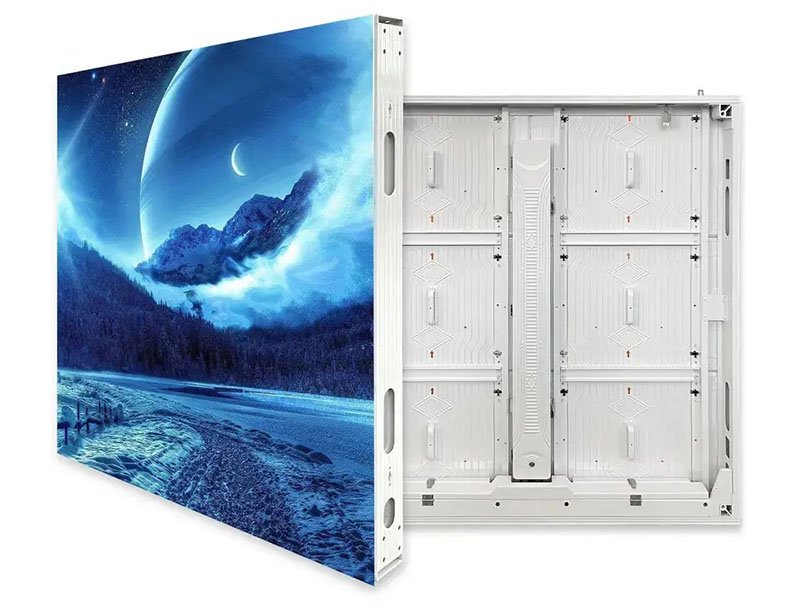
Before comparing materials, it is worth establishing exactly where aluminum extrusion sits in the system hierarchy of a large-format LED video wall.
| Structural Layer | Components | Aluminum Extrusion Role |
| Display layer | LED modules (PCB + diodes + mask) | Minimal (PCB substrate is typically FR4) |
| Cabinet layer | Structural frame + PSU + receiver card | Primary (main rails and horizontal bars) |
| Mounting layer | Rigging beams, locking hardware, wall brackets | High (profiles + die-cast corner joints) |
| Cabling layer | Cable trays, data hubs, power distribution | Medium (often integrated into profile channels) |
The cabinet layer is where material selection has the largest downstream impact. The frame must simultaneously provide a dimensionally stable mounting surface for the LED modules, serve as a passive heatsink for the electronics, create a weatherproof enclosure for the power supplies, and provide rigging points for lifting and wall-mounting. Asking a single structural member to do all of these things well is why the manufacturing process — not just the material — matters so much.
Material Comparison: Aluminum Extrusion vs. Die-Cast Aluminum vs. Bent Steel
The first decision point for any LED cabinet specification is material and process selection. The following table provides a systematic comparison across the dimensions that matter most:
| Parameter | Aluminum Extrusion | Die-Cast Aluminum | Bent Steel Sheet |
| Density (g/cm³) | 2.70 | 2.65–2.75 | 7.85 |
| Typical alloy | 6063-T5 / 6061-T6 | ADC12 / A380 | Q235 / SPCC |
| Thermal conductivity (W/m·K) | 155–201 | 96–160 | 50–60 |
| Flatness tolerance | ±0.1 mm/m | ±0.2–0.5 mm | ±0.3–1.0 mm (post-weld) |
| Cross-section complexity | High (multi-function channels in one pass) | Very high (3D complex geometry) | Low (bend radius limits) |
| Tooling cost | Low ($400–$2,000 per die) | High ($7,000–$45,000 per die) | Very low (press tooling) |
| Weight vs. equivalent steel | ~65% lighter | ~65% lighter | Baseline |
| Corrosion resistance | Excellent (after anodizing) | Good | Poor (requires galvanizing) |
| Field repairability | High (individual profiles replaceable) | Low (whole casting scrapped) | Medium |
| Best fit | Mid-to-large outdoor, rental screens | Fine-pitch indoor, high-precision screens | Budget-sensitive fixed large-format |
Selection Guidance
Choose aluminum extrusion when:
- Pixel pitch is P2.5 or larger (outdoor fixed or rental)
- Weight is a primary constraint (rooftop installations, suspended displays, touring productions)
- The design requires integrated channels for drainage, sealing, and rigging
- Budget favors low tooling cost with medium-run quantities
Choose die-cast aluminum when:
- Pixel pitch is P1.5 or finer (fine-pitch indoor LED)
- The cabinet geometry requires complex 3D features that cannot be achieved by cutting extruded profiles
- Dimensional precision at corner joints is paramount (broadcast virtual production walls, control room displays)
Choose steel when:
- The primary structure is very large (>200 m²) and the frame is a secondary substructure behind the extrusion-based cabinet units
- First cost is the overriding criterion and long-term maintenance cost is acceptable
Alloy Selection: 6063-T5 vs. 6061-T6 — Which One and Why
The two alloys that cover approximately 90% of LED display extrusion applications are 6063-T5 and 6061-T6. They share a similar base chemistry (aluminum-magnesium-silicon) but differ meaningfully in mechanical properties and extrudability.
| Property | 6063-T5 | 6061-T6 |
| Ultimate tensile strength (MPa) | 185 | 310 |
| Yield strength (MPa) | 145 | 276 |
| Elongation at break (%) | 8 | 12 |
| Thermal conductivity (W/m·K) | 201 | 167 |
| Extrudability | Excellent (thin walls, complex sections) | Good (minimum wall ~1.5 mm) |
| Anodizing quality | Outstanding | Good |
| Relative cost | Baseline | +15–25% |
6063-T5 is the workhorse alloy for LED cabinet horizontal bars and face rails. Its higher thermal conductivity (201 W/m·K vs. 167 W/m·K for 6061-T6) makes it the better passive heatsink material. Its superior extrudability allows designers to create thin-walled, multi-channel cross-sections with integrated cooling fins — something 6061-T6 cannot achieve at the same wall thickness without die instability.
6061-T6 is appropriate for primary structural members that carry higher mechanical loads: main rigging beams, wall-mounting brackets, and load-bearing vertical columns in large outdoor billboard structures. Its tensile strength of 310 MPa approaches that of mild steel (400 MPa) while weighing one-third as much.
Procurement warning: Some suppliers ship 6063-T4 (under-aged) material in place of T5 as a cost reduction. T4 temper achieves only about 75% of the tensile strength of T5. Always request a Mill Test Report (MTR) that specifies both the alloy designation and the temper condition. Reject shipments without traceable documentation.
Thermal Management: Calculating Whether Your Extrusion Profile Can Handle the Heat Load
LED displays convert only 30–40% of electrical input into visible light. The remaining 60–70% becomes heat that must be removed from the LED junction — or brightness decays, color shifts, and lifespan drops precipitously. For sealed outdoor cabinets without active cooling fans, the aluminum extrusion frame is the thermal management system.
Estimating Heat Load by Display Type
| Display Type | Typical Power Density (W/m²) |
| Outdoor P8–P10 standard brightness | 800–1,200 |
| Outdoor P4–P6 high brightness (10,000 nit) | 2,000–3,500 |
| Indoor P3–P4 fine-pitch | 400–700 |
| Rental P3.9–P4.8 | 900–1,400 |
| Transparent grille screen | 200–500 |
Natural Convection Heat Dissipation Formula
For passively cooled extruded aluminum frames, the heat dissipated through natural convection from the fin surfaces is:
Q = h × A_fin × (T_surface − T_ambient)
Where:
- h = natural convection coefficient for vertical aluminum fins: 5–12 W/m²·K
- A_fin = total fin surface area in contact with air (m²)
- T_surface − T_ambient = allowable temperature rise, typically designed for 25–40°C
Worked example:
A 600 mm × 600 mm LED cabinet has a rear extrusion frame with 8 cooling fins, each 35 mm tall and 560 mm long. Total fin area:
A_fin = 8 fins × 2 sides × 0.035 m × 0.56 m = 0.31 m²
Q = 8 W/m²·K × 0.31 m² × 30°C ≈ 74 W
If the module power consumption for this cabinet is 65 W, the passive cooling margin is sufficient. If the power density increases to 90 W (e.g., for a high-brightness upgrade), additional fins, increased fin height, or anodized black finish (which improves radiation emissivity from ~0.05 for bare aluminum to ~0.85 for black anodize) would be needed.
Key Fin Geometry Rules
| Parameter | Recommended Range | Reason |
| Fin pitch (spacing) | 12–20 mm | Below 8 mm, airflow restriction eliminates convection gains |
| Fin height | 25–50 mm | Taller fins increase area but reduce effectiveness per mm above ~60 mm |
| Fin thickness | 1.5–3.0 mm | Minimum for structural integrity during extrusion |
| Surface finish | Black anodize (AA15) | Increases radiation contribution by up to 15–20% |
Structural Strength: Wind Load Calculation and Section Verification
Outdoor LED displays are classified as structures and must meet local building codes for wind resistance. The extrusion profile selection must be verified against calculated loads — not just assumed adequate.
Wind Pressure Calculation
The design wind pressure on a flat LED screen panel:
W = 0.5 × ρ_air × V² × Cd × A
Where:
- ρ_air ≈ 1.25 kg/m³ at sea level
- V = design wind speed (m/s) — coastal zones: 45–55 m/s; inland: 30–40 m/s
- Cd = drag coefficient for flat panels: 1.3 (conservative; perforated screens may use 0.8–1.0)
- A = projected screen area (m²)
Example: A 5 m × 3 m (15 m²) rooftop billboard at a coastal site with design wind speed 50 m/s:
W = 0.5 × 1.25 × 50² × 1.3 × 15 = 30,469 N ≈ 30.5 kN
Section Modulus Check for Extrusion Rails
For a horizontal extrusion rail spanning the full cabinet width, the maximum bending stress must not exceed the allowable stress for the alloy:
σ = M / W_section ≤ [σ]
Where:
- M = bending moment at midspan (N·mm)
- W_section = section modulus of the extrusion profile (mm³), available from the supplier’s profile CAD drawing
- [σ] = allowable bending stress: ~160 MPa for 6061-T6 (with 1.5× safety factor); ~100 MPa for 6063-T5
For complex cantilever joints and multi-panel arrays, finite element analysis (FEA) using ANSYS or similar software is strongly recommended, particularly at die-cast corner bracket connections where stress concentrations are highest.
The Multi-Function Extrusion Cross-Section: Engineering Integration in One Profile
The defining competitive advantage of aluminum extrusion over bent sheet metal is the ability to consolidate multiple functional requirements into a single continuous profile. The following diagram represents a typical high-end LED cabinet horizontal rail cross-section:
◄── FRONT (module-facing side) ──────────────────────────────────►
┌───────────────────────────────────────────────────────────────────┐
│ [T-slot] [Cable raceway] [Gasket dovetail] [Magnetic screw port] │ ← Module mounting face
│━━━━━━━━━━━━━━━━━━━━━━━━━━━━━━━━━━━━━━━━━━━━━━━━━━━━━━━━━━━━━━━━│ ← Main load wall (3–5 mm)
│ ‖ ‖ ‖ ‖ ‖ ‖ ‖ ‖ Cooling fins │ ← Rear (ambient air)
│ ‖ ‖ ‖ ‖ ‖ ‖ ‖ ‖ │
└───────────────────────────────────────────────────────────────────┘
◄── REAR (ambient air / heatsink side) ─────────────────────────────►
Functional zones integrated in one extrusion (typical premium specification):
- Front T-slots → Module attachment without drilling. T-nuts slide to any position, accommodating modules from different generations.
- Dovetail gasket channel → EPDM rubber sealing strip snaps in mechanically. No silicone required as primary weatherproofing; seal is field-replaceable in 30 seconds.
- Internal cable raceways → Power and signal cables run through hollow chambers entirely hidden from view. Eliminates all external cable exposure.
- Side rigging channels → Hoist eyes and tilt brackets bolt directly into side T-slots. No field drilling required on installation day.
- Rear cooling fins → Integral fin array increases heat transfer surface area by 3–5× vs. a flat rear plate.
- Precision alignment faces → Machined datum surfaces on the front face and vertical sides ensure cabinet-to-cabinet Z-seam alignment within ±0.1 mm without shimming.
This integration is why a high-quality extruded aluminum frame reduces installation time by 30–40% and maintenance time by 50–60% compared to equivalent functionality built from multiple bolt-together components.
Outdoor Display Structures: Specific Engineering Challenges and Solutions
Moving an LED display from a controlled indoor environment to an outdoor installation multiplies structural demands by a factor of 5–10. Here are the critical challenges and how correctly specified aluminum extrusion addresses each one.
Thermal Expansion Management
Aluminum’s coefficient of thermal expansion (CTE) is approximately 23 × 10⁻⁶ /°C — nearly twice that of steel (12 × 10⁻⁶ /°C). For a 6-meter-wide all-aluminum screen frame exposed to a temperature swing from −20°C (winter night) to +70°C (summer sun-heated surface):
ΔL = 6,000 mm × 23 × 10⁻⁶ /°C × 90°C ≈ 12.4 mm
A 12 mm total expansion across 6 meters is non-trivial. Engineering responses:
- Inter-module gaps: Design 0.5–1.0 mm elastic clearance between adjacent module edges
- Slotted fastener holes: Vertical connection plates use elongated (slotted) holes rather than round holes to permit controlled thermal sliding
- Homogeneous material system: An all-aluminum frame (profiles + corner joints both aluminum) expands uniformly as a single body. Hybrid steel-aluminum structures develop internal thermal stresses at connection points, which accelerates fastener fatigue and frame warping over time.
Weatherproofing Without Silicone Dependency
Outdoor screens typically require IP65 (dust-tight, water-jet resistant) or IP66 (high-pressure water-jet resistant). The critical design principle is to achieve this through geometry, not sealant. Silicone cures and works well at installation, but degrades in UV exposure over 5–8 years, creating the most common failure mode in outdoor screens.
| Waterproofing Layer | Implementation | Silicone Dependent? |
| First defense (module face) | Module lip overlaps cabinet face frame by 2–3 mm | No |
| Second defense (module perimeter) | EPDM gasket in extruded dovetail slot on cabinet frame | No |
| Third defense (drainage) | Integrated drainage gutter extruded into horizontal bar; weep holes at bottom | No |
| Supplemental seal | Neutral-cure silicone at die-cast corner joints only | Yes (secondary) |
The labyrinthine drainage channel — a continuous groove machined into the horizontal extrusion profile that collects any water penetrating the module gap and redirects it to outlet weep holes — is only achievable through extrusion geometry. It cannot be replicated with bent sheet metal at comparable cost.
Corrosion Protection by Environment
| Treatment | Film Thickness | Salt Spray (ASTM B117) | Recommended Application |
| Anodize Class AA10 | 10 μm | ~500 hours | General indoor use |
| Anodize Class AA15 | 15 μm | ~1,000 hours | Standard outdoor |
| Anodize Class AA25 | 25 μm | ~1,500 hours | Coastal/humid environments |
| Hard anodize AA50 | 50 μm | 3,000+ hours | Marine/salt spray zones |
| PVDF fluorocarbon paint | 30–60 μm | ~2,000 hours | Architectural facade screens requiring color |
For screens within 1 km of a saltwater coastline, AA25 or hard anodize is the minimum acceptable specification.
Rental and Staging: High-Cycle-Life Requirements
Concert touring and live event LED screens represent perhaps the most demanding use case for aluminum extrusion. A touring backdrop may be assembled and struck in a different city every night — accumulating 200+ build/dismantle cycles per year.
Key Engineering Requirements for Rental Cabinets
Structural fatigue at lock points: The eccentric cam-lock system (quick-lock) used in rental panels must engage with precisely machined conical seat features in the extrusion profile. Tolerance at these points: ≤±0.05 mm. 6063-T5 extrusion profiles maintain this tolerance through 10,000+ lock cycles with negligible deformation. Equivalent welded steel frames typically show measurable warping after 1,000 cycles.
Weight targets: Standard rental cabinet targets:
| Cabinet Size | Maximum Weight Target | Max. Area Density |
| 500 mm × 500 mm | ≤6.5 kg | ≤26 kg/m² |
| 500 mm × 1,000 mm | ≤12 kg | ≤24 kg/m² |
| 600 mm × 600 mm | ≤8 kg | ≤22 kg/m² |
Speed of deployment: A properly engineered extruded rental cabinet allows two technicians to build a 10 m² video wall in under 5 minutes. This requires: precision alignment cones that self-locate cabinets within ±0.1 mm on initial contact, one-motion cam locks that simultaneously achieve face alignment and mechanical locking, and integrated carrying handles recessed into the extrusion side channels.
Creative and Architectural Applications
Curved Displays
A flat LED module cannot curve; the PCB fractures at tight radii. But for large-radius architectural curves (R > 3 meters), the cabinet frame can be curved while the modules remain flat — producing a smooth visual arc from the viewer’s distance.
Curved extrusion profiles are achieved by:
- Post-extrusion CNC stretch bending: Straight extrusion pulled over a curved mandrel while still warm. Achieves radii down to approximately 800 mm for typical cabinet profiles.
- Segmented die design: The extrusion die itself has a slight radius introduced into the bearing length. Produces a consistent curve on every cut length without secondary operations.
Transparent and Grille Screens
Transparent LED screens for retail windows and building facades use extruded aluminum fins as the primary vertical structural element. These blades — typically 15–30 mm wide and 8–12 mm deep — perform four simultaneous functions: carry LED strip PCBs on their face, route data cables through internal hollow chambers, conduct heat from the LED strips along their length, and provide visual transparency between the fins when the screen is dark.
The architectural elegance of a transparent screen depends entirely on the blade’s dimensional precision. A profile with ±0.2 mm width tolerance across 3 meters of height would be visually unacceptable. Extruded aluminum holds this to ±0.05 mm without secondary machining.
Sustainability and Total Cost of Ownership
Environmental Case for Aluminum Extrusion
| Dimension | Aluminum Extrusion | Steel Structure |
| Recyclability | >90% (infinitely recyclable without quality loss) | ~85% |
| Energy to recycle vs. primary production | Only 5% of primary smelting energy | ~25–30% for steel |
| Weight reduction vs. steel (same strength) | 60–65% lighter | Baseline |
| Transport carbon reduction (per ton-km saved) | Significant at scale | — |
| End-of-life residual value | High (aluminum holds commodity value) | Medium |
Carbon calculation example: A 10 m × 6 m outdoor display using aluminum extrusion framework saves approximately 2.8 metric tons of weight vs. a steel-equivalent design. At 0.15 kg CO₂ per ton-km for road freight, a 500 km deployment round trip saves approximately 420 kg CO₂ from transport alone — before accounting for the energy savings during the building’s structural reinforcement that heavier steel would have required.
Total Cost of Ownership vs. First Cost
Buyers who optimize for lowest cabinet first cost often specify folded steel or thin-wall die-cast frames. The following comparison illustrates the TCO gap over a 10-year outdoor installation:
| Cost Category | Aluminum Extrusion Cabinet | Folded Steel Cabinet |
| Purchase price index | 1.25× | 1.0× |
| Structural reinforcement savings (lighter load) | −$15,000–$40,000 | $0 |
| Anti-corrosion retreatment (years 5, 8) | $0 (anodize is permanent) | $3,000–$8,000 |
| Module replacement labor (front-access service) | 1 technician, 15 min/module | 2 technicians, 45 min/module |
| Frame replacement due to warping/corrosion | Rare (>15-year life) | Common (8–10-year life) |
| Shipping cost (weight-based) | Lower | Higher |
For most commercial outdoor installations, the aluminum extrusion premium pays back within 2–3 years through structural cost savings alone.
Procurement Decision Framework
The following decision tree consolidates all variables into a practical specification guide:
PROJECT START
│
├─ INDOOR OR OUTDOOR?
│ │
│ INDOOR ──► Pixel pitch?
│ │
│ P1.5 or finer ──► Die-cast aluminum preferred
│ (precision, 3D geometry)
│ P2.0 or coarser ──► Aluminum extrusion
│ (weight, cost, thermal)
│
└─ OUTDOOR ──► Installation type?
│
├─ FIXED (building facade / billboard)
│ │
│ ├─ Coastal / high-humidity zone?
│ │ YES ──► 6063-T5 frame + AA25 anodize
│ │ + integrated EPDM drainage
│ │ NO ──► 6063-T5 + AA15 anodize
│ │
│ └─ Wind zone (>40 m/s design speed)?
│ YES ──► 6061-T6 main structural beams
│ + FEA verification required
│
├─ RENTAL / TOURING
│ ──► 6063-T5 + CNC-machined lock seats
│ Weight target: ≤32 kg/m²
│ Fatigue life: >10,000 cycles
│
└─ ARCHITECTURAL / CURVED
──► Post-extrusion CNC bending
OR purpose-designed curved die
Minimum bend radius: ~800 mm (profile-dependent)
Technical Reference: Quick-Lookup Parameters
| Parameter | Value / Range |
| 6063-T5 thermal conductivity | 201 W/m·K |
| 6061-T6 ultimate tensile strength | 310 MPa |
| 6063-T5 ultimate tensile strength | 185 MPa |
| Aluminum CTE | 23 × 10⁻⁶ /°C |
| Steel CTE | 12 × 10⁻⁶ /°C |
| Aluminum density | 2.70 g/cm³ |
| Steel density | 7.85 g/cm³ |
| Natural convection coefficient (vertical fins) | 5–12 W/m²·K |
| Optimal fin spacing for natural convection | 12–20 mm |
| Wind drag coefficient (flat screen) | 1.3 |
| Allowable bending stress, 6061-T6 (SF 1.5) | ~160 MPa |
| Allowable bending stress, 6063-T5 (SF 1.5) | ~100 MPa |
| Standard extrusion billet lengths | 6 m / 6.5 m / 12 m |
| IP65 salt spray minimum (ASTM B117) | ≥1,000 hours |
| Rental cabinet maximum area density | ≤32 kg/m² |
| Black anodize emissivity (radiation) | ~0.85 |
| Bare aluminum emissivity | ~0.05 |
Conclusion:
Aluminum extrusion is not simply a material choice — it is a manufacturing strategy that determines how many functional requirements a single structural component can satisfy simultaneously. In a well-designed LED display cabinet, one extruded aluminum rail manages structural load, passive heat dissipation, weatherproof drainage, module alignment, cable management, and rigging attachment. No other manufacturing process delivers this level of functional integration at comparable cost and weight.
As LED technology continues its advance toward tighter pixel pitches and higher brightness levels, heat density will only increase and tolerance for structural deformation will tighten toward zero. Aluminum extrusion, with its unique combination of geometric precision (±0.1 mm/m as-extruded), high thermal conductivity (up to 201 W/m·K), and alloy strength (up to 310 MPa for 6061-T6), is well-positioned to meet those demands.
For anyone specifying an LED video wall, the four documents that separate an engineering-grade cabinet from a visually indistinguishable but mechanically inferior alternative are: the extrusion profile cross-section drawing, the Mill Test Report confirming alloy and temper, the salt spray test report, and the wind load structural calculation. A supplier who cannot provide all four is asking you to accept engineering risk on their behalf.
The next time you stand in front of a seamless, high-brightness LED wall — whether at a stadium, a concert, or a city-center building facade — you are looking at the output of a display process that started not with the LEDs, but with the geometry of an aluminum extrusion die.